
Firearms training
Firearms licensing
Canada’s firearms licensing process has three key steps. We deliver the first one: the federally mandated safety courses, taught by RCMP-certified instructors.
How licensing works
Three steps to your PAL
To legally own or acquire firearms in Canada, you need a Possession and Acquisition Licence (PAL), issued by the Royal Canadian Mounted Police (RCMP).
1
Safety training
Start with the Canadian Firearms Safety Course (CFSC), which covers non-restricted firearms. Want restricted firearms too? Add the Canadian Restricted Firearms Safety Course (CRFSC) to put the restricted endorsement on your PAL.
2
Application
Put your file together: supporting documents, a photo signed by your guarantor, and proof that you completed your course. The best way to file your application is online.
3
Security screening
Next comes a background check, including interviews with your references and with current and former conjugal partners. First-time applicants also have a mandatory 28-day waiting period.
Licences are valid for five years and must be renewed before they expire. On Point Training delivers the safety training only; we are not involved in the application process or in communications with the Chief Firearms Officer.
Licensing courses
Which course do you need?
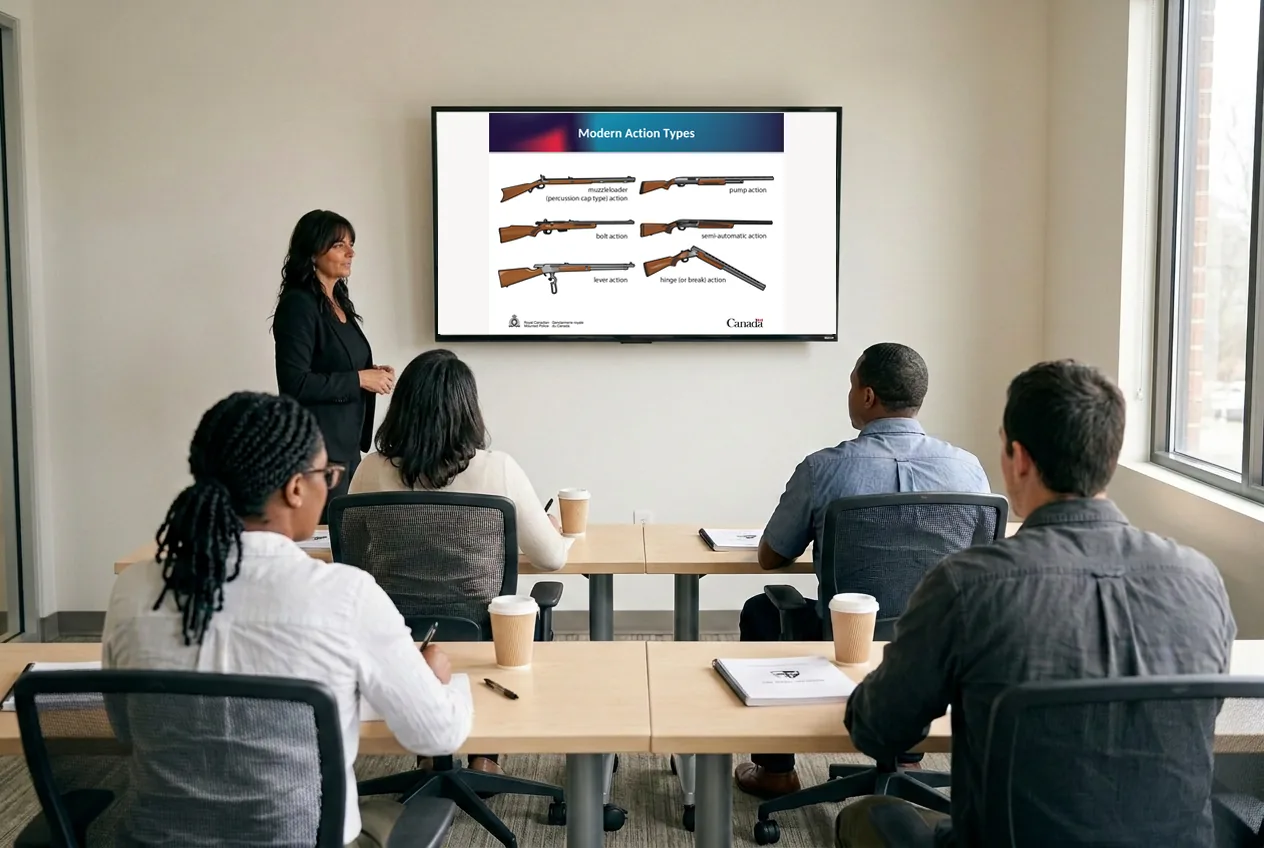
Both courses are taught by RCMP-certified instructors and are entirely classroom-based, with no live-fire component.

CFSC: your first step
The mandatory first step toward your PAL for non-restricted firearms. If you have never held a firearms licence in Canada, this is where your journey starts.

CRFSC: add restricted firearms
The next step toward the restricted endorsement to your PAL. Taking the CFSC and CRFSC together saves on the courses, and applying for both at the same time saves on the RCMP application fee.
Looking for something else?

We know delivery
How our courses are delivered
Small classes. The CFSC and CRFSC have a maximum student-to-instructor ratio of 12:1, which keeps every class personal.
RCMP-certified instructors. Both courses can only be taught and examined by instructors certified by the RCMP, and both are entirely classroom-based.
Public and private courses. Public courses are sold per seat, from one to twelve seats per purchase. You can also arrange a private course for your own group. We travel anywhere in BC, including remote locations, First Nations communities and work camps. Contact us to discuss your needs.
We know equity
Learning that works for everyone
Education should be accessible to everyone. Stepping back into a classroom can feel intimidating, especially if you have struggled in traditional learning environments or have not studied in years. We know that test anxiety is a very real hurdle, but be assured, we are here to help and guide you through it with dignity and discretion.
Whether you face challenges with reading or writing, live with autism or ADHD, or simply worry about looking foolish, our instructors create a safe, judgment-free space to learn. Every student can succeed with the right guidance and support.

Questions people ask
Licensing - frequently asked questions
Does the course give me my firearms licence?
No. The CFSC and CRFSC are the federally mandated first step toward your PAL and restricted endorsement (RPAL). If you complete the course and achieve satisfactory pass scores on the written and practical exams, you pass and receive a course completion certificate. Include it with your application form and payment, and send it to the Canadian Firearms Program, which assesses the application and decides whether the licence is granted. We only facilitate the courses and examinations; we don't administer the licensing process.
Can I take the CFSC and CRFSC together?
Yes. Taking both together saves on the course fees, and applying for the PAL and the restricted endorsement at the same time saves on the application fees. The application fee schedule is set by the RCMP.
Can youth take the CFSC?
Yes. To apply for a Minor’s PAL, a person must be between 12 and 17, complete the CFSC and pass the two-part test. They then need parental or guardian consent, and the application goes to the Chief Firearms Officer (CFO) of their province or territory. A Minor’s PAL is valid until the minor turns 18, when they apply for an adult PAL. They don't need to take the course or exams again.
Why are classes limited to 12 students?
The Chief Firearms Officer mandates a maximum of 12 students per instructor, per course. Most of our students take the combined CFSC/CRFSC course, so seats can fill quickly.
Can I just turn up on the day?
No. All courses are pre-booked and pre-sold, so please book your seat in advance. Find the next dates below.
What if I can't make the course?
Our Refund policy sets out your options for cancelling, deferring or being refunded. Contact us if you need to talk it through.
Upcoming firearms courses
All courses are pre-booked, so secure your seat ahead of time.

Proudly supporting
Proud business members of the CCFR
We are proud business members of the CCFR, and we credit them as the primary organisation responsible for opposing the continued constraints on Canadian firearms owners pushed by the federal government.
We strongly urge all firearms owners and enthusiasts to support the CCFR through membership and to purchase the legal insurance available to all members.