
Licensing course
Canadian Firearms Safety Course (CFSC)
The mandatory first step toward your Possession and Acquisition License (PAL). Taught by RCMP-certified instructors in a classroom, with no live fire, and open to complete beginners.

At a glance
Everything you need to know before you book
Length
8 to 10 hours of tuition, excluding examination time
Class size
Up to 12 students per instructor, mandated by the Chief Firearms Officer
Prerequisites
None, and no minimum skill level. You must not be subject to a current firearms prohibition
Format
In person, classroom only. Hands-on handling uses deactivated firearms and inert ammunition. No live fire
Language
Taught in English. Written examinations in French are available on request
Exams
A 50-question multiple-choice written exam and a classroom practical handling test. The exams can no longer be challenged without attending the course

We know licensing
Your mandatory first step to a PAL
The Canadian Firearms Safety Course (CFSC) is designed for novice firearms users and is the mandatory first step in obtaining your Possession and Acquisition License (PAL). A PAL gives you the legal ability to possess and acquire non-restricted firearms and ammunition in Canada. Licenses are typically valid for five years and must be renewed.
We provide expert instruction for the CFSC portion of the licensing process. Once you achieve the required pass marks on both the written and practical examinations, you can apply to the Chief Firearms Officer (CFO) for your PAL. The written exam is a 50-question multiple-choice paper. The practical exam assesses your safe handling of firearms in a controlled classroom environment.
The course is taught in a safe and friendly environment with both classroom and hands-on tuition. Live fire and range visits are not included in this course.
The CFSC can only be taught and examined by instructors certified by the RCMP.
Where this fits
Your path to a PAL
The CFSC is step one. It's the step we deliver.
1
Take the CFSC
Complete the course and achieve the required pass marks on the written and practical exams. You receive a course completion certificate.
2
Apply for your PAL
Send your certificate with the application form and payment to the Canadian Firearms Program. Adults complete form RCMP 5592 (also called CAFC 921E).
3
Screening and license
The CFO screens every applicant, including background checks and interviews with references and current and former conjugal partners. A mandatory 28-day waiting period applies to first-time applicants. Your license then arrives in the mail.
On Point Training only delivers the course and examinations. We are not involved in the application process and cannot contact the CFO on your behalf.
Course outline
What you'll learn
The course is taught in a safe and friendly environment with both classroom and hands-on tuition. It covers:
An introduction to the safety course
The Canadian Firearms Program
The four ACTS of firearms safety
An introduction to firearms
The evolution of firearms
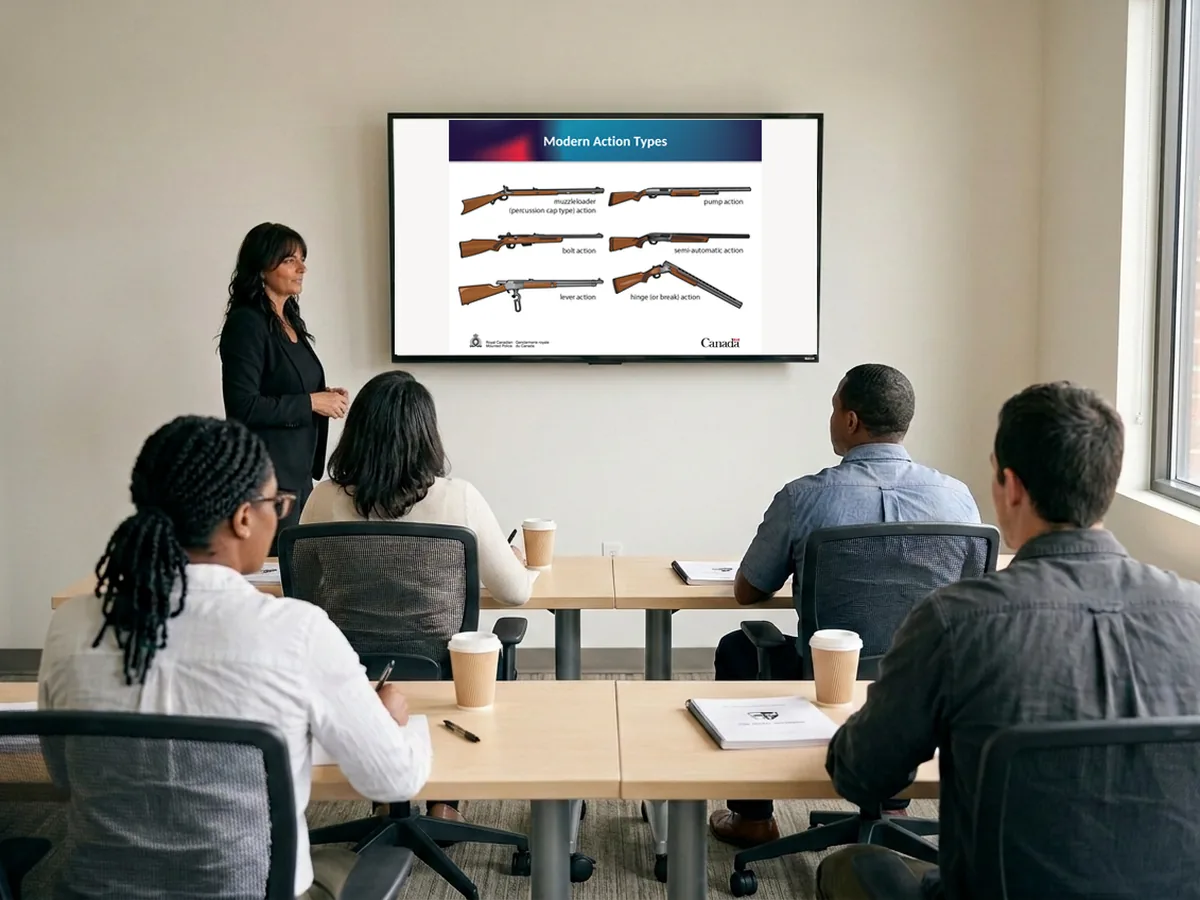
Different types of actions
Major firearm parts
ACTS & PROVE
Basic safety practices
Loading and unloading procedures
Ammunition
Operating the different firearm actions
Safe handling and carrying of non-restricted firearms
Firing techniques and procedures for non-restricted firearms
Safe storage, display and transportation
Social responsibilities, and much more
What to expect
A focused, personal day of learning
Our CFSC and CRFSC courses are limited to 12 students per instructor, which keeps learning focused and personal in a safe, engaging and supportive environment. Lessons combine lectures, class discussions and hands-on handling of deactivated firearms and inert ammunition, so you gain both knowledge and confidence.
Our instructors discreetly assess individual learning styles and adapt their approach to maximize retention. Stepping into a classroom can feel intimidating, but handling firearms is a fun and rewarding experience when guided by expert instructors.
Bring valid photo ID, and come well-rested.
Eligibility: you must not be subject to a current firearms prohibition.
Exams: the written and practical exams are part of the course. They can no longer be challenged without attending.
The manual: you don't need it, but you're welcome to read it. The eBook is free in English and French.
Learning challenges
You can do this, and we'll help
We believe that educational opportunities should be available for everyone, and we strongly encourage those who think they can't to become believers in themselves and see that they can. We know it takes a little help and sometimes a lot of help, but we aspire to be your trusted partner as you pursue your goals.
We promise to treat you with respect, dignity and confidentiality. Whatever challenge you face, trust us to help you overcome it. If you face barriers such as reading or writing difficulties, ADHD, autism, classroom anxiety or a physical impairment, tell us before you book and we'll talk it through.

Minors licensing
Aged 12 to 17? You can start now
If you're between 12 and 17, you may apply for a Minor's License after completing the CFSC and passing both the written and practical exams. It allows you to borrow and use non-restricted firearms for activities such as hunting, target shooting and organized competitions.
Your Minor's License expires when you turn 18, and you then apply for a PAL. You don't need to retake the CFSC, because your exam results remain valid.
The application involves form RCMP 5485. Contact the Chief Firearms Officer in the province where you'll use the firearm for the correct application process. Parents and guardians don't need to attend the class with a minor, but they are welcome to.
Before and after
Make the most of your CFSC

Not sure licensing is right for you?
We meet many people who have never handled a firearm or been to a shooting range. If that sounds like you, try one of our range courses first, so you can be sure that getting licensed is the right thing for you.

Planning to add restricted firearms?
The CRFSC is the next step, for the restricted endorsement to your PAL. Taking the CFSC and CRFSC together offers significant savings on both the courses and the application fees.

Planning to hunt?
If you pass the CFSC, you're exempt from the practical firearms handling exam in the CORE hunter education program, as long as the examiner has your CFSC course report. We keep it on file for our own students.
Questions people ask
CFSC frequently asked questions
Does the CFSC give me my firearms license?
No. The CFSC and CRFSC are the federally mandated first step toward your PAL and restricted endorsement (RPAL). If you complete the course and achieve satisfactory pass scores on the written and practical exams, you pass and receive a course completion certificate. Include it with your application form and payment, and send it to the Canadian Firearms Program, which assesses the application and decides whether the license is granted. We only facilitate the courses and examinations; we don't administer the licensing process.
Can I just turn up on the day?
No. All courses are pre-booked and pre-sold, so please book your seat in advance. Find the next dates below.
Why are classes limited to 12 students?
The Chief Firearms Officer mandates a maximum of 12 students per instructor, per course. Most of our students take the CFSC/CRFSC courses together, so seats can fill quickly.
What if I can't make the course?
Our Refund policy sets out your options for cancelling, deferring or being refunded. Contact us if you need to talk it through.
My license expired. Do I need to take the course again?
It depends. That's up to the CFO. In our experience, students who previously took and passed the CFSC are usually allowed to renew without retaking the course, although PAL holders who were grandfathered from a FAC, or who challenged the exams before 2014, are usually required to retake the course. It's not a hard rule. Start by calling the CFO on 1-800-731-4000 or visit the CFO website.
I have questions about storage, transport or display.
Keep a copy of the government-issued interpretation handy. We carry a printed copy in our vehicles and gun cases, so everyone is working from the same official information if you're ever stopped while transporting firearms. Download it in English or French.
I'm Indigenous. Do I need the CFSC to own firearms legally?
Indigenous peoples are not exempt from the CFSC and CRFSC, but there are two possible alternative pathways: elders may apply for alternative safety certification by demonstrating their firearms knowledge to the CFO, and Indigenous adults may apply if they can show that the course is not reasonably available or accessible due to time, location or cost. These pathways are at the CFO's discretion and you must still meet all other PAL requirements. See the RCMP guidance or contact your CFO.
Upcoming firearms courses
All courses are pre-booked, so secure your seat ahead of time.

Proudly supporting
Proud business members of the CCFR
We are proud business members of the CCFR, and we credit them as the primary organisation responsible for opposing the continued constraints on Canadian firearms owners pushed by the federal government.
We strongly urge all firearms owners and enthusiasts to support the CCFR through membership and to purchase the legal insurance available to all members.
Ready for your first step?
Book your CFSC seat, or add the restricted endorsement by taking the CFSC and CRFSC together.